Working with the fearful dog by Cathy Toft
Reprinted from the Collie Connection, Summer 1999
This issue's theme once again prompted me to update you on Babe's progress (she is the severely abused Collie sent to me by Lisa King of Colorado Collie Rescue). When I got Babe, I joked to myself and a few close friends that my goal was to get Babe doing agility in a year's time, or by December 1999. The first few weeks were so terribly difficult for both of us (see Winter 98 Collie Connection), in my weaker moments I rued setting such a lofty goal, even in jest. I was certain it would be impossible to attain. But surprise! Babe is now doing agility and loves it!
But let me back up. Last issue, I shared with you my other goal, getting Babe to come when she is called--and we are still far from that goal at the level I need to achieve. For Babe's safety, I need her to come to me if she somehow gets loose outside of my house and yard. Babe is so terrified of people that it is agony to come toward a human--she just can't do it, if she thinks I am trying to catch her or "trap" her. I began a program of small steps of getting her to come to me on the cue word C'mon (Spring 99 Collie Connection).
I recently realized that I am approaching this goal incorrectly. One day it became obvious to me that her recall was not really a matter of training. I was at my mother's house, and the dogs were out in the yard. It's my mother's custom to fix herself a glass of ice tea in the afternoon and while the spoon is rattling the glass and ice cubes, her Collies come in for an afternoon treat. When all the Collies but Babe appeared in the kitchen, my mother called "C'mon Babe!" I watched as Babe, who was still out in the backyard, popped up her head and with a brisk trot ended up in the kitchen for her treat. I should have realize sooner that Babe knows exactly what we want when we say "C'mon Babe"; it's just that she can't do it if she thinks we're trying to catch her (thanks to Jean Levitt for getting me to see this)..
There are actually two aspects to Babe's inability to come when she is called. The first is simply that typical of every dog--you know, the "I'll come when I'm done sniffing here, thanks" recall. You have to train a dog to come when you say come, no matter what. Eventually most trainers use negative reinforcement for this training, as it is a leadership issue as much as a training issue. I abandoned aversive training because, for Babe, coming to me was more unpleasant than anything I could humanely dish out to her. The second part of Babe's inability to come had to be worked on first, and that was reducing her fear of me and increasing her trust of me--and more than trust, I hoped that one day Babe would actually love me and want to be with me.
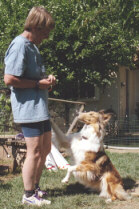 Now I devised a new plan. I would approach Babe's training in two venues. One would be to condition Babe to the actions that would permit me to catch her if she somehow got away. The second would be to continue to train Babe in all kinds of fun activities so that the structure and enjoyment of working with me would overcome her fear of people in general. Here Babe is demonstrating one of her parlour tricks. On the command "Just like Lassie!!!", Babe raises her paw and pats me with it.
Plan 1 then would be to reduce her fear of the specific actions or motions that would be required to get her back to me. I imagined her loose and me trying to catch her. Once I got close enough I'd probably grab for her collar. So I started conditioning her to this action when we were doing our nightly feeding and clicker training. For this, I suddenly whipped my hand out and thrust it toward her head. If she gave ground, then no click, no treat. I decided to accept her keeping her feet in one place for my unruly behavior, but allow her to duck her head. After all, ducking is a natural thing to do when someone takes a swing at you, and technically it would be too hard to communicate to her what ducking is or isn't with a clicker. But moving a foot is black-and-white and easy to communicate. Soon Babe was holding ground and ducking when my hand suddenly appeared and patted her on the top of her head or under her chin.
I soon realized that I was also conditioning her to accept the attention of strangers. All of us have had strangers come up when we are walking our beautiful Collies and ask if they can pet them. I wanted Babe to become socialized to normal life in suburbia, so this was a great way to train her to that. Sure enough, when I had Babe out and about, people came up, leaned over Babe and, while whipping a hand from out behind their backs, asked somewhat late "Can I pet your dog?" Babe was a trooper--she ducked and held her ground while they ruffled the fur on top of her head. To my amusement, I could clearly see the look on her face saying "OK, I endured this strange human greeting ritual. Now, where's my treat??????"
One day I was out in the yard trying to get Babe to come to me with no success. What worked in the kitchen was still not working out in the yard. When I said "C'mon Babe" she would bolt and try to escape the yard. A flash of anger and frustration came over me--yes, this has been a long hard process and I have been greatly discouraged and lost patience at times. But, Babe is training me to be a much better trainer, because it was so blatantly obvious to me that a show of anger would only set us back--it would accomplish nothing toward my goal. Suddenly my anger turned to a burst of inspiration! With no warning I began to do play bows and play "keep away," running from Babe and trying to hide from her sight behind a tree.
Babe went WILD!!! She was in utter disbelief that this monster (i.e., human) could play just like a dog! To make a long story short, I realized that Babe is an incredibly high drive dog. She has extremely high prey drive (i.e., the desire to chase), high play drive (she loves fun and games, it's just that she was too afraid to play for so long), and as it turns out a high drive to work. When she is terrified for some reason, her food drive disappears long before her play/prey drives. I began to tap into those high drives to overcome her fears, and our training took on a whole new dimension.
That's where this issue's theme comes in. One day I became bored with the things I was teaching Babe to do. With Megan, my youngest and most talented Collie, I don't take any initiative in her training--I depend on my trainers to give me the program in obedience, agility, and herding, so that I don't ruin her for her future training. But with Babe, all bets are off--there are no rules and nothing to lose. So when I get bored, I start to fool around with her and say to myself "what can I teach Babe today???"
That day I thought, shoot, why not teach Babe to jump over the hurdles? How would I do that? Hmm. 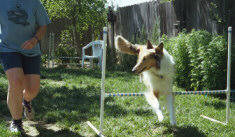 Why don't I get Babe first to follow my flat hand (palm facing down, fingers parallel with the ground)? Using a clicker, of course, (can't touch Babe or compel her in any way, remember!), I tucked a piece of food under my thumb and waited for Babe to come up and touch my hand to get the food. Nose touching my hand (this action was deeply ingrained now in her repertoire), click, treat. After two clicks with the food lure, I removed it and put out just my flat hand. Easy, no problem, nose touch, click, treat comes out of my other hand. Repeat a few times, then raise the criteria. Move my hand, make her follow it, make her have to catch up to it. Click, treat. Now turn to the right, then to the left, then run. It's such a joy working with a truly clicker trained dog, as Babe now is. A truly clicker trained dog recognizes the game, freely offers behaviors in different situations, and instantly understands the meaning of the click in a novel context. In a few minutes, Babe would follow my flat hand anywhere.
Next I got out the hurdles. I removed all the bars and just left the uprights. This was a hard step. Babe knew what I wanted immediately, which was to follow my flat hand through the uprights. But now her sense that I was compelling her to do something overcame her. She bolted away and would not get near the uprights. I tapped into her play drive and overcame the fear. After some hesitation, she crossed through the uprights. The instant she was between the uprights, click, treat. Yes!! Now she understood, this was part of the game!! Soon she was charging through the uprights with great abandon. By the end of a 20 minute or so session, she was jumping an 8" bar.
I was on such a high from this success, I couldn't wait to have a second session. I made myself wait several hours, and then that afternoon I had her outside again. I knew that I was risking failure, but I just couldn't help myself. My fears were unfounded--by the end of the second session she was jumping 12". I decided to leave it at that for the day. Wow! I'd reached my goal in April! I'd had Babe only 5 months and she was in agility training!
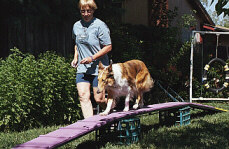 Progress came fast. In the second session I trained her to the pause table. I'd already trained her to the "placeboard" which is a tool I use for all of my dogs, in all aspects of their training, and the pause table with 8" legs was only a slightly higher placeboard. In that session I had her jump two 12" hurdles and end up with a sit on the pause table. Heady with all this success, within the next few weeks I taught her to do the dog walk on baby legs (about 12"),
 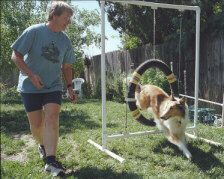 and I started working on the tire. The tire was the hardest. Her fear of being compelled and trapped overcame her for several sessions, but when I used the other dogs as models and rivals, she soon caught on that going through the tire was the only thing that would result in a click and treat!
These amazing new developments caused me to press her to learn to "down" on command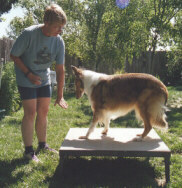 --after all, an agility dog needs to down on the pause table! For weeks I'd been trying to teach her to down on command with the traditional clicker trainer's method of luring her with a piece of food drawn toward her on the ground. But this action set off her fears, and ironically, I could not get her to do on command the one action I thought I'd never get her out of--the down! Here Babe is refusing to down on the pause table. Eventually, I used my other Collies as models, and then one day, she downed after watching them down and get all the treats, whereas her running around, barking and offering every other behavior in her repertoire got no treats. With a clicker, I could instantly communicate to her that was the action I wanted, so from that moment on, she knew the "down" on command. It would still take several more weeks for her to understand that down doesn't mean I'm trying to trap her, and now she downs quickly and eagerly.
The nice consequence of this achievement was that we took a huge step toward my goal of training her to allow me to catch her. She will now down and allow me to come up to her. Eureka! I feel like having a party!
In the months that I've gotten to know Babe, I've realized what an exceptionally intelligent, high drive dog she is. These are just the dogs that end up in shelters, either because they cannot be handled easily by ordinary pet owners or because, as in Babe's case, she might have been so easy to traumatize when she was young. I don't know if Babe will ever become a fully functional working dog, achieving her considerable potential. I am certain, however, that I can tap into Babe's high intelligence and drives to overcome her mental handicaps. Given her remarkable progress, I'm now reluctant to assume any limits with this Collie. Go for it, Babe!
Pictures of Babe and me doing agility are courtesy of Sue Larson; thanks, Sue!

Babe Top|Rescue Top|Site Map